You've done the research. Half of the literature says one thing, the other half says the opposite. It's so annoying, you could nut someone.
But that's what scientists do at the creative edge; pick away at the unknown, chuck it behind them, and then have a few (peer-reviewed) fights with each other about what's valuable. It just so happens you have got mixed up in this weird process.
So, how do you handle a mixed literature? Stay on the fence and say 'On the one hand this, on the other hand that'? No. Be bold! Jump off! Make the field you land in home and then chuck mud at the others.
In other words, settle on a position, acknowledge the criticisms but think of ways in which they could be wrong (is their methodology crap, are their assumptions poor?). Or can the other position be assimilated into your account. Does the fence even need to be there? Psychology students frequently get bogged down in false dichotomy. One way to be creative is to find compromise, a third way.
You could have a module nestled within a general purpose system (so in some tests it looks like a module, in others a domain-general system). You could have a innate mechanism that requires experience to be activated. You could have an account of consciousness that is still computation (functionalism) just in a different flavour from the digital one most people assume (like quantum).
Now, I am not saying to run polemically as far from the fence as you can. You may like to be cautious (cautious is good) and stay close to it whilst arguing one side. Just for the sake of your reader, for the sake of your ability to demonstrate that you can defend one side and be critical of the other and for the sake of coming up with a creative compromise get off the fence and muck in.
This will only be of interest to a fraction of geeks, like myself, who like really fringe stuff.
When two sounds with two different frequencies are played in stereo (i.e. to each ear), binaural beats are heard. These aren't real but equal to the difference between the stereo frequencies. You can listen to one here (headphones needed, toggle between each ear to see the effect vanish).
There are several companies that claim such binaural beats improve mental functioning and memory by reverse engineering brain frequencies via the audio. Naturally, the combined simplicity and complexity of this idea caught certain people's imagination, to the point that a musician-physicist mate of mine wondered it there was anything to it last year during exams.
There isn't. In this recent studybinaural beats had zero effect on brain frequencies and, what is more, participants in the experimental group were more forgetful and more depressed than controls. Cognitive neuroscience, one. New Age monkeys, nil.
(If you want to see more on music and revision, see this post.)
So its seems like one of those beautiful messes the psychology literature likes to get itself in, but I would make a judgement: the only evidence for is either selective or compromised by the finding of negative effects. Plus the 2007 papers fail to replicate the earlier effects. So, to answer your question: no, it doesn't improve memory. In fact, it may make it worse and just puncture your alertness.
Patient in hospital presenting with alien arm syndrome following basilar tip aneurysm rupture. Comments below video on YouTube page are quite interesting.
Short documentary about Gerald, a man with schizophrenia. Part 1 and 2 shown below.
Also, there is a bank of stuff on the disorder here. And, I can't remember where I recorded this from but it gives an insight into the subjective experience of the disorder. Someone has put sound effects over the top, presumably to match some of the heightened sense of reality and auditory hallucinations experienced by the patient.
You will have spent a long time on your essays, familiarising yourself with an area to exam-level detail. Fortunately, you only have to do an essay per course for coursework. Unfortunately, for exams you need to know lots more. One shortcut to familiarising yourself with all this other material is to read each others essays.
Last year many of the Level 3 psychologists compiled their essays on an online hub. Essays were uploaded along with the mark they got, any important comments made by the marker and without any identifying information.
The beauty of this is that you can quickly use the legwork done by others to get to a good level of understanding. In addition, you should be able to improve your own communication skills by noting in others what is effortless to read and what is horrible.
It's a great little resource and last year's was very successful but its power rests on you lot uploading your essays. To do this, first, remove your name from the doc, add your mark in a nice fat font size at the top (plus any marker comments you deem necessary), make sure the document is saved with the essay question in the file name and then head here to MediaMax and enter these details :
username: brain_milk password: i/l/i/k/e/s/h/a/r/i/n/g [remove all the "/" - this is to avoid bots]
After this navigate your way to right folder, or create your own if I have left one out, and upload.
Do make an effort to upload guys and gals, we all found it was a great thing to have last year...
Channel 4 produced a documentary on dyslexia a few years back. On the whole, I find Channel 4 docs have rather too much of an appetite for controversy at the expense of seeing things clearly, but it might be good if only to bring alive the area. I haven't seen it but you can watch it here.
The Space Shuttle flight deck - probably one of the most complex systems in the world - before Human Factors people got their mits on it.
The Space Shuttle flight deck after a Human Factors makeover.
GENERAL
Discuss why the value of cognitive ergonomics is being increasingly recognised by system designers. What is user centred design and why should it be used? Illustrate you answer with examples. All complex systems should have input from Human Factors professionals at all stages of development. Discuss. How can psychology inform design? Why is Human Factors engineering important? The commercial success of Apple products is often attributed to its 'user-centred design'. Discuss with other examples how this might be achieved throughout the product cycle. "The majority of design is system-centred. This is its downfall." (Madeupman, 2008). Discuss the statement and how the design process can be improved. You are writing a letter to the Dean of Engineering explaining why all students in her Faculty should have to take courses in cognitive psychology. Using examples, what would you argument be and why? "The most important component in design: the human". What might Thisdude (2008) mean by this? Illustrate your answer with examples.
SPECIFIC
Knowledge elicitation
What are the problems of knowledge elicitation and how might they be overcome? Why might it be hard to elicit knowledge from an expert? How might the problems be overcome? What is an expert and why might it be hard to elicit knowledge from them? Extracting useful knowledge from experts is impossible. Discuss.
Limits and Capabilities
How can we utilise our knowledge of perception in order to design better systems? How can an understanding of human capabilities and limitations be used in the design of complex systems? Illustrate your answer with examples. Discuss how human information processing models have assisted in the design of complex systems. You are asked to provide an ergonomics brief for a cockpit systems designer. What information would you give him and why? What factors should a complex system designer take into account if humans are to use the end product?
Input devices
How can the psychological literature assist designers of input devices? What ways can information get into a system and identify any problems that there may be in doing this. Critically assess ubiquitous input devices and suggest future directions for better interaction with systems. QWERTY dominates. Why?
The WIMP interface will not last. Discuss. How can knowledge of human cognitive abilities constrain the design of input devices? You are hired by Apple who are interested in a psychologist's perspective for the new MacBook. You are asked to give them a 1500 word brief on 'Improving Input Design'. Write this report.
Output devices
How can the psychological literature assist designers of output devices? Visual displays while dominant need not be the only way of presenting information to the user. Discuss. The Ministry of Defence hires you to help them build a new Tactical Operations Centre. They specifically want informed advice on output devices. What recommendations would you make and why? How can knowledge of human cognitive abilities constrain the design of output devices?
Interaction issues
What issues should a system designer take into account when developing a complex system? How can systems be made cognitively compatible? Illustrate your answer using examples. A significant trend in technology is to automate. Discuss the psychological interaction issues that arise out of this trend.
Role of Human Factors
Human Factors is just common sense. Discuss. What is wrong with the current role Human Factors plays in the life-cycles of many products and systems? What is the band-aid approach to Human Factors and why is it theoretically dubious? Where should Human Factors be deployed in the life-cycle or a product or system? Illustrate your answer with some recent examples.
Error
Using examples discuss why human error reduction should be holistic.
Humans make errors. What are the implications of this for the design of systems and products?
Why is human error such a difficult area of study?
In your justified opinion which models of human error can help reduce the risk of incidents and accidents?
How can Human Factors reduce the errors made by humans?
What is the ‘system design-induced error’ (Wiener, 1987) concept? How is it useful to Human Factors?
Why when trying to reduce human error are end-users only ‘half the story’?
The ‘band-aid’ approach to human error is wrong. Discuss.
When humans using systems make their first error, this is actually the second error: the first is designer's. Discuss.
Workload
What is mental workload, how is it measured and why it is important to the design of complex systems? Humans have limited mental resources. How might we be able to measure the use of these during tasks? What, if any, are the problems of this approach? In a new cockpit design it is found that pilots are being mentally overloaded. How might this conclusion have been drawn and what suggestions could a psychologist make to the designer?
Critically evaluate current measures of workload. Why is Human Factors interested in workload?
Evaluation
How would you evaluate a software package from a user-centred design perspective?
Discuss some of the advantages and disadvantages of formative evaluation.
Discuss some of the advantages and limitations of summative evaluation.
Compare and contrast summative and formative evaluation. Illustrate your answer with questions.
When should evaluation take place in the product lifecycle? Justify your answer.
How might a product or system be evaluated from a user-centred design perspective
58 minute long lecture on autism by Uta Frith, Professor in Cognitive Development at UCL and general big cheese in the study of autism:
And getting a bit closer to autism; ignore the sell at the end:
Also, if you like autism see a film called After Thomas, which superbly tells the true story of a family and the struggles they face with their autistic son. Keeley Hawes is fantastic.
Before you all head back to Bristol and swing the stats, here's an analytics map from omniscientGoogle showing where all you lot hail from when you pop by the blog.
I spoke about using metaphor a few posts back. This is basically thinking in pictures. Now, you can go beyond just using tropes and breathe visual life into these metaphors with actual pictures and videos salted and peppered throughout your revision.
Just like I try to put a pic at the top of each article that links to the article's content in an interesting and memorable way, so you could illustrate your revision notes with a few choice pics/Photoshop mash-ups/film stills that are odd enough to be highly memorable while still being relevant. (For memory geeks out there, this phenomenon where oddity improves memory is called the 'bizarreness effect'. Read more about in this Google book).
I strongly advise trying it out because you are going have to pack a lot in over the coming months. Even if you conservatively estimate that for each course there are 50 references to remember that's approximately 500 to somehow get into your head. This is the same sort of number that expert memorizers deal with when they remember multiple packs of cards or whatever their memory fetish is. There's a neuroimagingstudy that shows tricks like these are not due to difference in brains but difference in strategies.
The majority use a visual memory trick called the loci method, which dates back to the Greek poet Simonides of Ceos. You may have heard of it. Simonides was at a banquet when the roof collapsed. Many of the people were crushed beyond recognition and he was able to recall who was there by imagining the positions of people seated at their tables. I suggest having a brief read of this short review from TICS for the scientific account.
Whatever's going on beneath the brain's bonnet, one thing I am confident of is that this method works. As the author of the paper says, "Mnemonic methods are effective in generating associations between otherwise ‘meaningless’ or unrelated information, such as dates and names" (which precisely characterises a reference). There are stats somewhere that I can't find right now but which show big memories gains from using this method over the slog-it-out-write-'em-down-ten-times approach.
I did this for both references and essay arguments. Take the paper I mentioned a sec ago, for which the references is Ericsson (2003). Translate this into something memorable as you revise. How about it's 20:03 and Eric has forgotten (the paper is about memory) to pick his son up from school? Draw a little sketch of a panicked parent, the forlorn child and the clock on the wall.
For extended arguments you have built, you can do the same. I can still remember lots of the little stories I made up to mirror the arguments. Not only is this helpful to your learning but it injects some fun into the learning process (which probably makes your learning more effective).
One thing I like doing and which gives you a nice entry point to the loci method is to find a photo or make a sketch and then add details of the experiment in pithy form to the pic. I have uploaded a few for you all on my Flickr account, in the Mind Bites set (click here for the slideshow). If you fancy doing something like this yourself, you can use free Photoshop alternatives like the newly launched Photoshop Express, good old GIMP or easy-as-pie Flauntr.
You might scoff at this method as adding extra work to your already busy desk. Well, yes, but that information is more suited to the natural channels through which memories flow. So, it's a weird case of adding more information to do less work.
Other things might work for you, but this worked for me. Think in pictures and you'll think more clearly, remember better and enjoy the work more.
Here are a few I made earlier...
Split brain - the axe is attacking the posterior corpus callosum, which is the major information highway between the hemispheres.
Prosopagnosia, obviously. Less obviously, The F & G in the eyes stand for FusiformGyrus which is thought to be the associated dysfunctional area
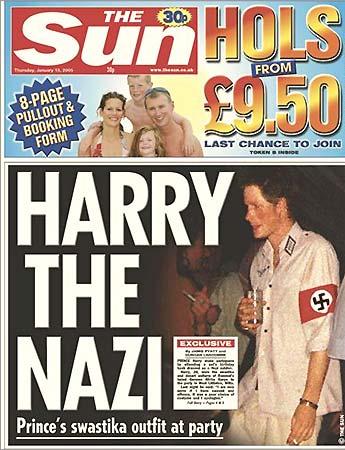
A symbol worn on the arm with connotations of hatred and being on the political 'right'. Useful for remembering misoplegia, which is hatred of a limb (e.g., an arm) due to right hemisphere damage.
Good one for neuropsychiatry: everything comes down to the brain (if its attended to) even distant cultural things, like The Simpsons.
The male cast of Friends for male sexual strategies. Joey, the high-genetic quality/high-masculinity/low-investing male who is massively polygamous ("How you doin' ?") vs Chandler the lower genetic quality/low masculinity/high investment male who is relatively monogamous. Ross appears to operate both strategies, which is a useful way of capturing context-dependent sexual strategies.
Another good one for the male polygamous strategy would be this Lynx ad which taps into this desire for many partners and portrays it in absurdly epic proportions.
This one is for optimal female sexual strategy. Here females are particularly attracted to high developmentally stable (masculine) males (cues to high genetic quality) around ovulation (hence the egg) meaning they can get all best resource investment off Mr Lovey and the best genetic investment off Mr Hottie.
Looking time/violation of expectancy paradigms can be remembered by the surprised baby.
Two clips for alien hand syndrome. The first from Red Dwarf
and the second from the combined genius of Sellers and Kubrick in Dr Strangelove
Topically, John Prescott, has today admitted to suffering from bulimia nervosa (purging type). His case is useful for neuropsychiatry because it shows this is not just a disorder that affects Western females, as the popular impression goes. Secondly, it smashes another popular myth: that eating disorders are merely the product of the media portraying skinny girls. I can't really see Prescott leafing through Vogue. That is not to say psychological factors are irrelevant; he says one of the causes of the disorder was stress - a known risk factor. There are lots of neurobiological correlates that are emerging (see Kaye, 2008, for a good review) but one Prescott might be useful for remembering is that the disorder has been associated with a 'crap' right temporal lobe (e.g. Levine etal., 2003). This is because Prescott is left-wing and considers the right 'crap'.
And finally, it's not a photo but it's barking up the same tree: "In this country, you gotta make the money first. Then when you get the money, you get the power. Then when you get the power, then you get the women."
- Tony Montana in Scarface.
The idea nested here is one the evolutionary psychology literature on risk-taking, aggression and homicide knocks about, namely, that access to females is the end goal, in the strict Darwinian sense. Power and wealth are means by which to get there and if you don't have these things it's worth taking risks for them.
Anyway, you get the idea. Go and be creative with your revision: it will sink in better...
To add page numbers to your revision bible simply, click VIEW>HEADER AND FOOTER. You should get this toolbar up.
Click the 'Switch between Header and Footer' button (in the pic above with a blue glow). Centre align yourself. Then select the 'Insert Page Number' (in the pic above with a pink glow). Choose what you want then press close.
This one's for Mac users only. It's called Genius. It helps you learn; might be useful for getting those references in. Find out more here. Download here.
Just off the back of the last post, I thought it might be useful to upload this. It's a spread sheet I nabbed off a physics student and modified to work out what you need to get in exams to get a certain classification knowing what your coursework marks are.
Basically, it takes your coursework marks and calculates that as a percentage of the unit. It then works out the number of extra unit percent you need to get up to 2.2, 2.1 and First. It then works out what this extra unit percent translates into for an exam. I am not so hot on the various cut off points for 2.2. and 2.1 are, so I added a box where you can tweak these factors.
I am pretty sure the maths in there is sound but if you see an error in the equations please do hurl abuse my way (via the comment box below or email) and I will get it changed.
If anyone knows the equation to work out overall mark then do pop it in the comments or email me. I think Level 2 is 1/3rd of the degree and Level 3 is 2/3rds, with coursework and exams in Level 3 making up 2/3rds (of the overall Level 3 2/3rds) and projects making up the remaining 1/3rd (of the overall Level 3 2/3rds). Ergh, complicated. I think that's how it works but not entirely sure.
(For those curious about the spreadsheet, I didn't get 10 in everything; I just changed all the marks to 10)
Someone emailed wondering when you get your project marks, which means lots of you will be wondering about when you get your project marks.
If last year is anything to go on, you will find out your project mark around the time you find out your exam marks, which is early-mid June. So as not to be working on the assumption that last year is correct for this year, you should pop into reception to confirm.
One thing this does mean is that a large portion of your marks remain unspecified, which makes guessing your overall standing more difficult, which, in turn, makes assigning the amount of effort to revision a tricky thing. In this fog of this uncertainty the best thing to do is simply revise hard and do the best you can do in the exams, giving yourself the benefit of doubt should your project fall short.
While it may seem obvious to do this, there is an attitude that if you are in 2.1 territory anyway it makes little difference what mark you get within this. '2.1 comfort', I call this. This is fine but also be aware that employers frequently look at marks and clearly a high 2.1 is more attractive than a low 2.1.
The dry business of acquisitions and mergers is given drama and clarity by this simple visual metaphor.
Those of you with a keener literary eye will have noted my heavy sprinkling of metaphor/analogy in my writing (and perhaps unintentionally comic occasions where they are extended beyond their elastic point, so they only lie limp in my text looking a bit silly [like now]).
Anyway, it's deliberate. Metaphors clear the corridors of our thinking and allow easy passage for arguments to glide down. They also improve your writing considerably.
Cognitive and Philosophy Wizard Daniel Hofstadter (and also author of the first book to ever be sold on Amazon.com) has called them "the core of cognition" (in Gentneretal., 2001. For pedants out there he was strictly speaking talking about analogy, but metaphor is a type of analogy).
Consider the differences between these two attempts to capture what the word 'greenwashing' means:
1. Greenwashing is a term that is used to describe the act of misleading consumers regarding the environmental practices of a company or the environmental benefits of a product or service
2. Greenwashing is when you "put a lettuce in the window of a butcher's shop and declare that you are now 'turning vegetarian'" (John Grant)
Although the first is more accurate, the second gives you the same gist but with much more satisfaction, clarity and gumption.
The reason I bring it up is because metaphor is not only for use over in the English department. Science papers and books frequently employ it to satisfying and "aah, now I get it!" effect.
At its best a metaphor should promote understanding beyond that of literal text, affording a deeper grasp on the issue. At its worst metaphor is deployed for flowery effect at the expense of crisp communication.
There's a paper I remember (but not well enough to cite) that was explaining the drawbacks of neuroimaging's resolution and it likened the situation to flying over a city a night, being able to see the lights below but being completely oblivious to the economics, politics and culture going on beneath.
This isn't just showing off because it shoehorns understanding and makes metaphorical predictions (we need to get down at the grassroots (cognitive and neuronal) levels to understand these other things).
In exams, slipping in a metaphor every now and again can pull the point you are making into sharp focus, significantly polish your communication and enhance the marker's understanding. Now, you may think I am getting a bit ahead of myself suggesting this as a way to improve your writing because it's irrelevant right now (you want to worry about that in May/June).
It isn't. In revision, using metaphor can greatly enhance your own understanding and memory of something because it forces you to chuck an idea about between two different modes. As a result it forces you to understand it at a deeper level, and when you codify at a deeper level you remember better (Slamecka and Graf, 1978). And, the really good ones should let you think more creatively and critically, which you'll need for the top marks.
When you are writing your notes try and think up useful metaphors and analogies because it will enliven the process, forge deeper memories and make you better thinkers.
Make Brain Milk my homepage!
It's got everything you need: Google search, the latest research, links out to all sorts of goodies and, of course, posts to help you bump up your marks. (N.b. this link may not work on Firefox, but if you have Firefox you'll know how to make this your homepage anyway.)