Showing posts with label papers. Show all posts

Wednesday, 30 April 2008

More sharing

ryanr @ Flickr

So, you asked. I looked. And now I am happy to say, I've found. Here is one of last year's Level 3 online hubs, now integrated into MediaMax. Apparently there were others but they have since been deleted.

Well done to everyone from Level 3 who has uploaded their stuff: excellent work. And for the people using it without uploading anything: tut. (Note, this is classic evo psych thing going on here: there's a group dependent on resources, givers are rewarded and cheaters get punished.)

To the Level 2 people: where are you? There are about 150 people visiting Brain Milk each day, so some of you have got to be Level 2. Upload people.

Thursday, 24 April 2008

Lasering depression

khazaei @ Flickr

In a first, scientists have isolated hyperactive parts of the brain in depressed patients using a laser dissection microscope. They found differences at the molecular level relative to controls, which could explain the hyperactivity and pave the way for new therapeutic strategies. This is great stuff for Neuropsychiatry folks.

Reference
Wang, S-S, Kamphuis, W., Huitinga, I., Zhou, J-N & Swaab, D.F (in press). Gene Expression Analysis in the Human Hypothalamus in Depression by Laser Micro-Dissection and Real Time PCR: the presence of multiple receptor imbalances. Molecular Psychiatry

Wednesday, 23 April 2008

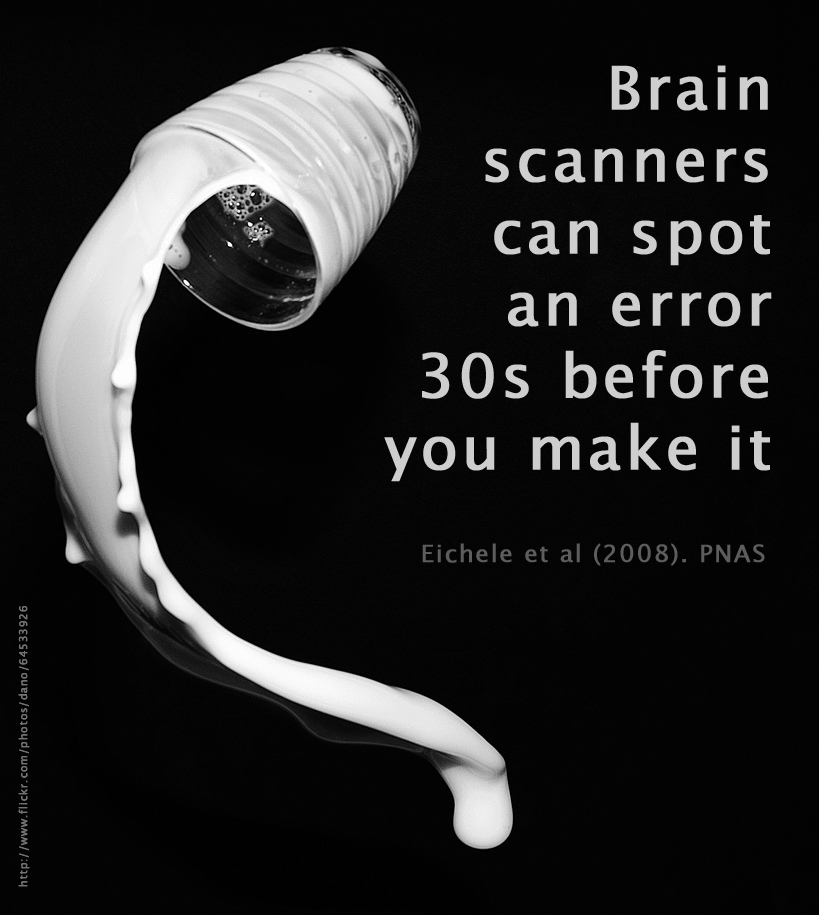
Neuroerror

will-lion @ Flickr

Cool new paper out in PNAS. Might be useful for Human Factors section on Error.

Tuesday, 22 April 2008

The online hub

bfionline @ Flickr

You will have spent a long time on your essays, familiarising yourself with an area to exam-level detail. Fortunately, you only have to do an essay per course for coursework. Unfortunately, for exams you need to know lots more. One shortcut to familiarising yourself with all this other material is to read each others essays.

Last year many of the Level 3 psychologists compiled their essays on an online hub. Essays were uploaded along with the mark they got, any important comments made by the marker and without any identifying information.

The beauty of this is that you can quickly use the legwork done by others to get to a good level of understanding. In addition, you should be able to improve your own communication skills by noting in others what is effortless to read and what is horrible.

It's a great little resource and last year's was very successful but its power rests on you lot uploading your essays. To do this, first, remove your name from the doc, add your mark in a nice fat font size at the top (plus any marker comments you deem necessary), make sure the document is saved with the essay question in the file name and then head here to MediaMax and enter these details :

username: brain_milk
password: i/l/i/k/e/s/h/a/r/i/n/g
[remove all the "/" - this is to avoid bots]

After this navigate your way to right folder, or create your own if I have left one out, and upload.

Do make an effort to upload guys and gals, we all found it was a great thing to have last year...

Wednesday, 9 April 2008

Two thousand and eighting

Referencing the most recent research immediately says to the marker that you have had a scoot around the literature and are at the cutting edge. It's so impressive and will give markers a nice warm feeling.

The only way a "(2008)" can be topped in your essay is with an "(in press)". That said, you can probably beat that with an "(in preparation)"; you're so in the groove you're citing papers that haven't yet been finished.

That's the major reason I have put the "Cutting edge" links over in the top right. They are updated automatically based on syndicated content taken direct from research groups or universities' news outlets. There might be the occasional oddity but all the research is hot off the press and hopefully there will be an occasional gem that makes you think, 'Ooh this would be great in...".

Where the 'Cutting Edge' links fall short, use PubMed or whatever you use to search and then sort the results so that the most recent is first. I believe you can also set up automated emails based on search terms using PubMed, so you are informed when anything new comes out.

The other neat thing about the most recent papers is that the first couple paras of the introduction should (if it is any good) bring you up to speed on the literature, including smoothing out any confusions that you may be getting upset over in older papers. So if you are getting in a muddle about things (which is normal) head for a recent paper to see if it can help.